Equipped with autonomous navigation technologies developed by Furuno, the domestic coastal container ship "GENBU," the only newly constructed as part of The Nippon Foundation’s fully autonomous ship initiative "MEGURI2040," *1 successfully commenced the world’s first commercial service*2 under level 4 autonomous navigation*3 on January 30, 2026. Prior to this, it completed its trial operations and received certification from ClassNK as an autonomous vessel on January 26. On January 28, it passed Japan’s vessel inspection standards specifically for autonomous ships, as required by the Ministry of Land, Infrastructure, Transport and Tourism(“MLIT”).
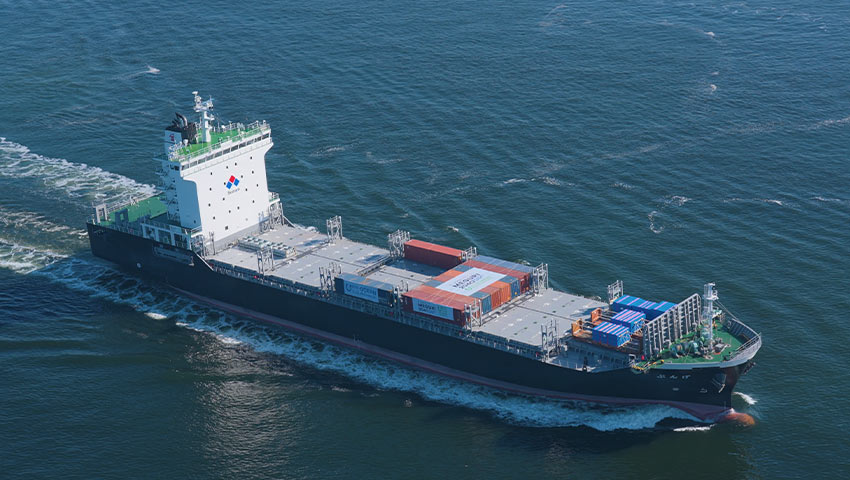
The coastal container ship "GENBU"
This milestone marks the wider adoption of autonomous vessels, showcasing the potential of cutting-edge technology to transform the maritime industry. By reducing the burden on seafarers, improving working conditions, and stabilizing logistics, autonomous shipping is expected to contribute significantly to enhancing the global competitiveness of Japan’s shipbuilding and maritime sectors.
Furuno’s contribution to MEGURI2040
Furuno has been an active participant in The Nippon Foundation’s fully autonomous ship initiative "MEGURI2040" since its first stage in February 2020. During the second stage, Furuno has contributed to the development of autonomous navigation systems and land-based Fleet Operation Center through three projects, aiming to advance the practical implementation and social adoption of fully autonomous vessels.
In "GENBU," a container ship fully equipped with autonomous operation capabilities, Furuno developed and installed the core technology for autonomous navigation: the Maneuvering Support System*4. This system integrates Furuno’s collision avoidance algorithm "SRU: Ship Routing Unit," which calculates collision avoidance route based on surrounding vessel data, obstacles, and the ship’s planned course. The system visualizes collision risks and avoidance routes on an APU (Action Planning Unit) screen, supporting safe and informed navigation decisions. The system has successfully obtained Technology Qualification (TQ) certification from ClassNK. This certification independently verifies the system’s safety and reliability, making it one of the most advanced autonomous navigation solutions in the industry.
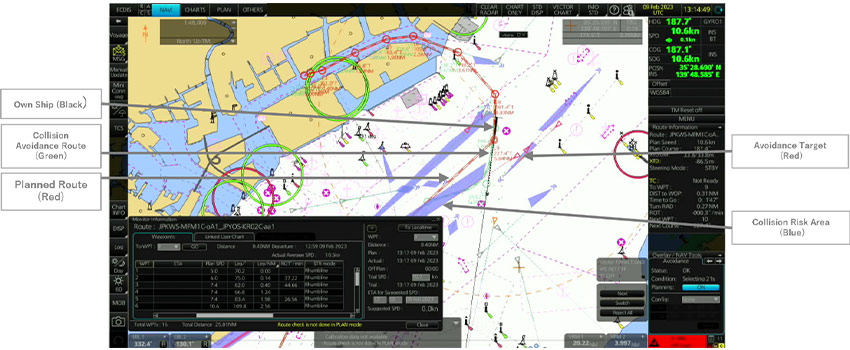
Furuno’s Maneuvering Support System using Ship Routing Unit (SRU)
The "GENBU" achieves Bridge Zero (B0) operations, removing the need for continuous crew presence on the bridge during autonomous navigation. To ensure reliability and safety, the ship’s system design incorporates redundancy for critical components, including the APU, which is responsible for collision avoidance planning. Even in the event of a single APU malfunction, the system is designed to continue autonomous operation without requiring immediate human intervention, maintaining safety standards equivalent to those of conventional vessels.
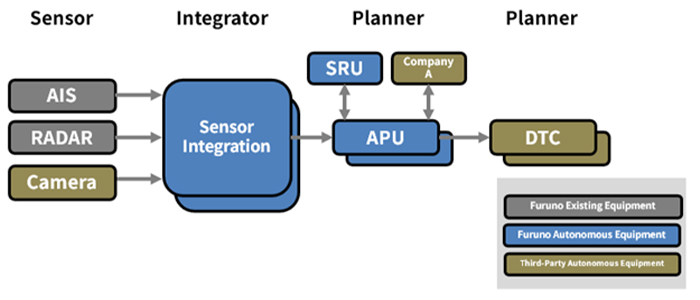
Ship system configuration for achieving B0 operations
The ship’s bridge is equipped with specialized bridge console developed by Furuno, designed to enhance operability and adaptability for various operational scenarios. The console is divided into three functional seating zones (front, middle, and rear), each optimized for specific tasks: monitoring during autonomous navigation, conventional navigation, and berthing operations. This layout allows efficient operation by a single watchkeeper, ensuring seamless transition between different operational scenarios.
This innovative bridge design has earned BRS1A certification*5 from ClassNK, signifying compliance with high standards for one-man watchkeeping and advanced safety management.
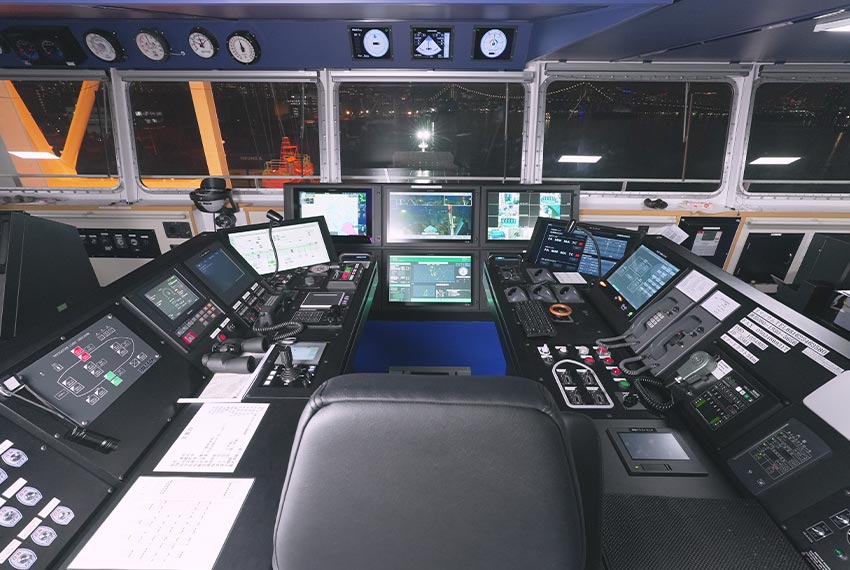
Bridge console of coastal container ship "GENBU"
Additionally, the ship’s bridge is equipped with Furuno’s Smart Bridge System*6, developed by its Swedish subsidiary, Furuno Sverige AB. This innovative system, adopted for the first time on a domestic coastal ship, consolidates navigation data onto customizable screens, enabling seamless control through a single trackball interface. This design significantly improves operational visibility and user-friendliness, ensuring safe monitoring even during fully autonomous operation. In addition, Furuno’s standard navigation equipment package, including marine radar and AIS, has been installed to support enhanced overall safety and operational efficiency.
Overview of coastal container ship “GENBU,” demonstration trials, and vessel inspection certification
The "GENBU" is a flagship vessel in the MEGURI2040 project, embodying the vision of transforming logistics infrastructure through automation. Designed from its inception for fully autonomous operation, the 134-meter-long, 700-TEU ship operates on a vital coastal route connecting Kobe, Osaka, Nagoya, Shimizu, Yokohama, and Tokyo. Coastal shipping accounts for approximately 40% of Japan’s domestic cargo transport (by weight), yet the industry faces severe challenges, including crew shortages and aging personnel. The "GENBU" aims to address these issues while serving as a model for future autonomous vessels.
To operate a vessel, it must pass inspections to ensure compliance with the technical standards stipulated by the government. In June 2024, MLIT established the autonomous ship working group to review and develop safety standards and inspection protocols for autonomous vessels. The working group published its findings in June 2025, laying the foundation for the regulatory framework governing autonomous ship operations.
To be classified as an “autonomous ship,” the vessel must undergo inspections to verify the proper functioning of systems such as sensors and planners, which are responsible for automatically calculating collision avoidance routes. On January 28, 2026, the "GENBU" successfully passed Japan’s vessel inspection standards, becoming certified as an autonomous ship.
Moving forward, “GENBU" will continue autonomous navigation during commercial service, with operational data collected for the development of further regulations related to autonomous vessels both domestically and internationally.
In the maritime industry, classification societies play a critical role in ensuring the safety and quality of vessels. These independent organizations provide certifications that are essential for securing insurance and financing. ClassNK has taken a historic step by creating the world’s first ship classification certification for autonomous ships, known as MASS. The "GENBU" has been recognized as the inaugural ship under this classification, marking a significant milestone in the social implementation of autonomous vessels.
*1: The MEGURI2040 project, led by The Nippon Foundation, is an initiative that aims to promote the practical implementation of autonomous ships by advancing technological development in this field. This effort is designed to further drive innovation and transform Japan’s logistics, economy, and societal infrastructure. The project is supported by a grant program and involves a consortium of 53 domestic companies under the framework of Designing the Future of Fully Autonomous Ships Plus (DFFAS+).
*2: The world’s first commercial service: As of January 2026, the "GENBU" has become the world’s first vessel to achieve regular commercial operation under Level 4 autonomous navigation technology on a scheduled cargo route. This groundbreaking milestone was confirmed by The Nippon Foundation’s research.
*3: Level 4 autonomous navigation refers to a technology stage where fully autonomous operation is possible under specific areas or conditions without human intervention. While the definition for autonomous navigation in shipping is still under discussion at the International Maritime Organization (IMO), this classification is currently adapted from automotive standards for convenience.
*4: Maneuvering Support System is a critical component of autonomous navigation, responsible for integrating information and planning routes to prevent collisions. It combines data from onboard systems such as radar, camera recognition, and environmental sensors, along with own ship information. Using proprietary algorithms, the system evaluates collision risks and automatically generates optimal avoidance routes, issuing steering commands to propulsion control equipment. This technology supports safe and efficient navigation by assisting captains and officers in decision-making.
*5: BRS1A certification issued by ClassNK, is a classification code based on bridge equipment regulations. It confirms that the ship’s bridge layout, operational environment, and navigation equipment meet high standards for one-man watchkeeping and advanced safety management.
*6: Smart Bridge System is an innovative bridge design developed by Furuno Sverige AB, Furuno’s Swedish subsidiary. It allows customizable displays tailored to different operational scenarios, enhancing both visibility and usability. By networking various electronic devices and displaying information as needed, the system provides intuitive control via a single trackball interface.
Related Links:
Announced on July 28, 2023:Participating in the Second Stage of the Nippon Foundation MEGURI2040 Fully Autonomous Ship Project for Social Implementation
https://www.furuno.co.jp/en/news/general/general_category.html?itemid=1359&dispmid=961