We are delighted to announce that Furuno plans to launch its new GF-100 Series dual-band GNSS Disciplined Oscillators (GNSSDO*¹) in November 2026.
The GF-100 Series includes models the GF-102, GF-103, GF-105S, and GF-105G.
Product lineup
Launch schedule
November 2026 (planned)
Background
GNSS-based time synchronization is a foundational technology for critical infrastructure that supports society, including telecommunications, power grids, financial systems, and broadcasting. While these infrastructures depend on accurate time to operate reliably, threats to GNSS signals, such as jamming*² and spoofing*³, have become increasingly real in recent years.
In this environment, what is required is the robustness to maintain service continuity even when incidents occur. Conventional holdover functions have primarily been designed for GNSS signal outages, such as those caused by antenna failures due to lightning strikes. However, in cases of jamming or spoofing, a receiver may continue to track abnormal signals, and conventional mechanisms alone may not be sufficient.
The GF-100 Series proactively detects such GNSS signal anomalies and automatically transitions to holdover operation using its built-in high stability oscillator. This enables stable time synchronization to continue while avoiding the adverse effects of abnormal signals.
The GF-100 Series adopts a Defense in Depth design, providing multiple layers of protection against a wide range of threats, from everyday degradation of the reception environment to intentional interference.
Equipment requiring precise time synchronization spans a wide range of applications, including telecom network systems, professional radio base stations, PTP grandmaster clocks, broadcasting equipment, satcom terminals and power monitoring systems. A GNSSDO integrates a dual-band GNSS receiver and a high-precision oscillator into a single module, allowing equipment manufacturers to incorporate time synchronization functionality, including measures against GNSS vulnerabilities, without having to develop it in-house.
By doing so, the GF-100 Series helps equipment manufacturers improve development efficiency and shorten time to market.
Main features
1. Proactive holdover upon detection of GNSS signal anomalies
When GNSS signal anomalies such as jamming or spoofing are detected, the GF-100 Series automatically transitions to holdover operation, enabling stable time synchronization to continue without being affected by abnormal signals. This function can be enabled or disabled according to operational requirements.
In addition to conventional countermeasures against GNSS signal loss caused by antenna failures or similar incidents, the GF-100 Series expands its design to proactively address intentional RF interference.
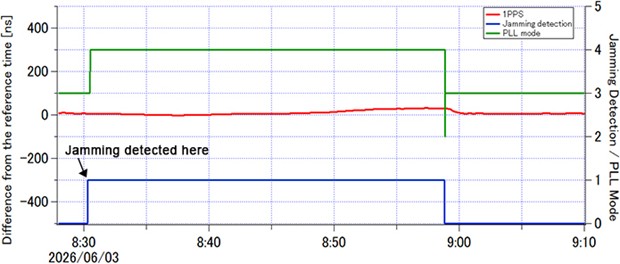
Active Holdover Behavior During Jamming Detection
2. L1 / L5 dual-band reception with fully independent L5 search
The GF-100 Series supports L1 / L5 dual-band reception, moving beyond conventional L1 single-band reception. It is equipped with a function that independently searches for L5 signals without relying on the L1 band.
Even when the L1 reception environment deteriorates, the GF-100 Series can continue time synchronization by utilizing the L5 band.
3. GNSS signal authentication (OSNMA / QZNMA)
The GF-100 Series supports Galileo’s Open Service Navigation Message Authentication (OSNMA*⁴) and QZSS’s Quasi-Zenith Satellite System Navigation Message Authentication (QZNMA*⁵).
By verifying the authenticity of received GNSS signals, it reduces the risk of timing anomalies caused by spoofed signals.
4. Dynamic satellite selection™*⁶
In multipath*⁷ environments commonly found in urban areas, the GF-100 Series dynamically selects satellites with higher signal quality to maintain high-precision time synchronization performance.
5. T-RAIM (Time Receiver Autonomous Integrity Monitoring)
The GF-100 Series continuously evaluates the reliability of satellite signals used for time synchronization and automatically excludes abnormal satellite signals.
6. Compact design and hardware compatibility
The GF-100 Series is available in two form factors: Short (34 × 27 × 15.5 mm) and Grande (100 × 52 × 14.1 mm).
Previously, Furuno’s top-tier holdover performance of ±1.5 µs/24h was available only in the grande form factor with the GF-8805. With the GF-105S, equivalent performance is now achieved in the small form factor, reducing the mounting area by approximately 80%.
All models maintain hardware compatibility with the current GF-880x Series, making replacement in existing equipment straightforward.
Recommended antenna
By combining the GF-100 Series with the recommended antenna, AU-500, users can maximize the performance of the GF-100 Series. The AU-500 offers high noise immunity and IP67-rated environmental resistance.
Reference information: participation in Jammertest
Furuno has continuously participated in Jammertest, an international GNSS vulnerability testing event held in Andøya, Norway, since 2024. Through this event, Furuno has been verifying the resilience of its GNSS receivers under real-world jamming and spoofing environments.
In September 2026, Furuno plans to conduct real-environment resilience testing using the GF-100 Series. The GF-100 Series incorporates insights gained through Furuno’s previous testing activities.
Furuno will continue to support the stable operation of social infrastructure, including telecommunications, broadcasting, and power systems, through its GNSS and time synchronization technologies.
*1 GNSSDO: Abbreviation for GNSS Disciplined Oscillator. A device that controls a high-precision oscillator using GNSS signals and outputs stable frequency and time signals.
*2 Jamming: The act of interfering with GNSS signal reception by transmitting radio interference. This includes not only intentional interference, but also cases where radio waves emitted from nearby communication equipment or other sources interfere with GNSS signals.
*3 Spoofing: The act of transmitting fake GNSS signals to cause a receiver to obtain incorrect position or time information.
*4 OSNMA: Abbreviation for Open Service Navigation Message Authentication. A signal authentication function provided by Galileo.
*5 QZNMA: Abbreviation for Quasi-Zenith Navigation Message Authentication. A signal authentication function provided by QZSS.
*6 Dynamic Satellite Selection™: A multipath mitigation technology based on an algorithm devised by NTT.
*7 Multipath: A phenomenon in which satellite signals are reflected by buildings or other structures and reach the receiver via multiple paths. It can degrade time synchronization accuracy.
Related Links
The information provided in this release is accurate as of the date of announcement and may be subject to change without prior notice.